Life beyond the website: building customer experiences for an agentic future
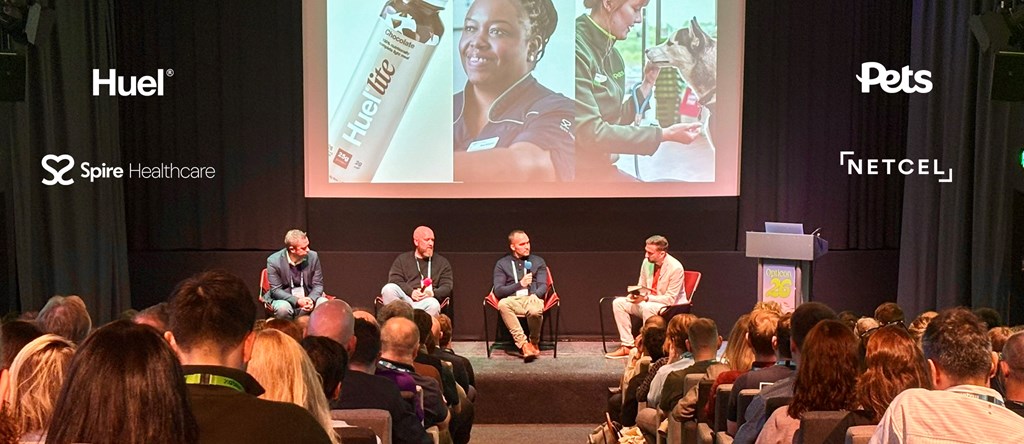
Insights from a panel discussion featuring Ollie Scheers (CTO, Huel), Alistair Leach (Director of Omnichannel Product, Pets at Home) and James White (Director of Marketing, Spire Healthcare), hosted by Tom Denbigh, (Director of Client Strategy & Growth, Netcel) at Opticon London 2026.
For decades, the website sat at the centre of the customer experience. Today, that centre of gravity is shifting.
Customers are turning to AI assistants, communities, marketplaces and third-party platforms to discover, compare and validate options long before they reach a brand-owned channel. The challenge for digital leaders is no longer how to optimise a website, but how to create connected experiences that build trust and influence decisions wherever they happen.
This was the focus of the panel discussion, Life beyond the website, at Opticon London 2026, Optimizely's flagship event for digital, ecommerce and marketing leaders. Bringing together voices from Huel, Spire Healthcare and Pets at Home, the discussion explored how AI is reshaping customer behaviour, where organisations are seeing value today, and what it takes to build customer experiences fit for an increasingly agentic future.
Despite representing very different sectors, the panellists arrived at a strikingly similar conclusion. Success won't come from adopting AI for its own sake. It will come from combining trusted data, connected experiences and responsible experimentation to solve real customer problems.
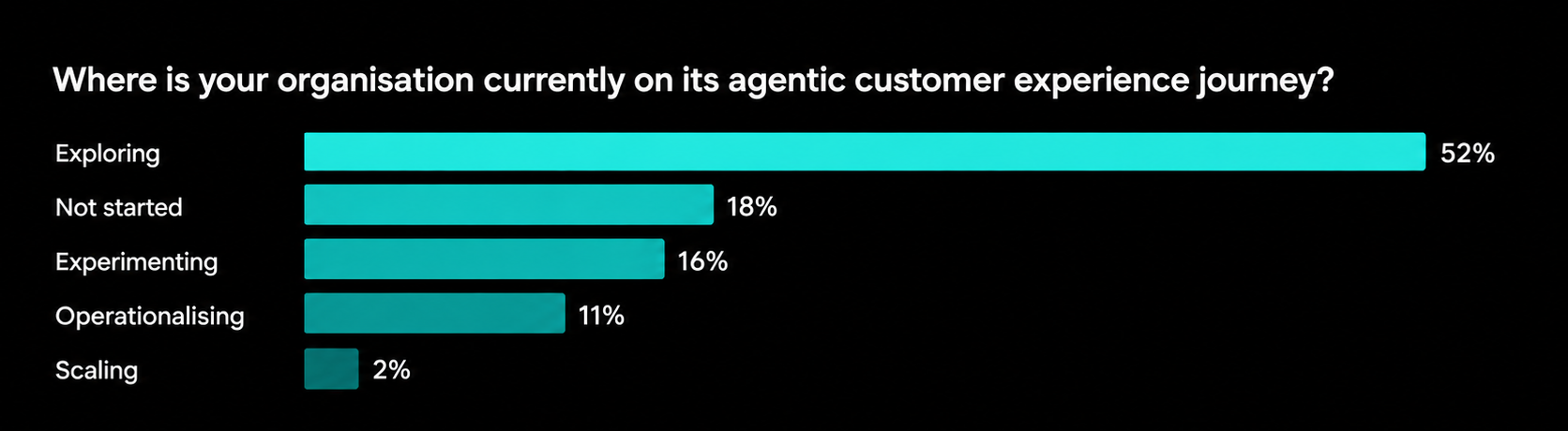
The audience polling reinforced that view. More than half of attendees described their organisation as still exploring what agentic customer experiences could mean for their business, while a further 18% had yet to begin. Only a small minority said they were actively scaling or operationalising agentic capabilities.
Taken together, the discussion and poll results paint a clear picture of where the market is today. Most organisations no longer need convincing that AI matters. The challenge now is moving beyond experimentation and turning potential into measurable value.
AI is already reshaping discovery
Some of the clearest signs of change are emerging at the very beginning of the customer journey.
James White, Director of Marketing, explained how Spire Healthcare is already seeing a shift in how people seek information and advice. As large language models become a more common starting point for research, fewer people are relying on traditional informational content. Yet that hasn't translated into less demand. Instead, more high-intent customers are arriving later in the journey with a clearer understanding of their needs and a greater readiness to act.
That distinction matters. Falling website traffic does not necessarily signal declining engagement. In many cases, it may simply indicate that discovery and consideration are taking place elsewhere.
For Spire Healthcare, this has reinforced the importance of ensuring trusted, expert-led content can be found across the wider digital ecosystem. The goal is not simply to bring people back to a website, but to ensure they encounter credible information wherever they begin their search.
For digital leaders, this requires a broader definition of visibility. The question is shifting from "How do we bring people to our website?" to "How do we ensure our expertise can be found, trusted and understood wherever our customers are?"
Personalisation should begin with relevance
Another theme during the discussion was the evolution of personalisation.
For years, organisations have approached personalisation as a technology challenge, focusing on algorithms, automation and recommendation engines. Alistair Leach encouraged attendees to think about it differently.
"The word I prefer to use is relevance. Ultimately, we're trying to understand what the customer wants and make it as relevant as possible to what they need."
Alistair Leach, Director of Omnichannel Product, Pets at Home
It's a subtle distinction, but an important one.
Customers value personalisation when it delivers relevance. They care whether an experience understands their context and helps them achieve what they came to do.
At Pets at Home, much of the work so far has focused on building the foundations that make relevance possible: improving data quality, connecting systems and creating a clearer understanding of customer needs across retail, veterinary and insurance services. The ambition is not simply to personalise interactions, but to create a joined-up experience across every touchpoint.
The lesson is straightforward, even if the execution is not. Relevance depends on connected experiences. Customers should not feel as though they are starting again every time they move between channels, devices or interactions.
Efficiency matters, but not at the expense of trust
The discussion also highlighted the significant value AI is already creating inside organisations.
At Huel, AI is being applied across software development, content production, localisation and customer service, helping teams work more efficiently and scale activity more effectively.
However, efficiency was never presented as the end goal.
"Our big focus has been: how can we use AI, and drive AI adoption, to improve efficiency within the organisation and ultimately give a better customer experience?"
Ollie Scheers, CTO, Huel
That mindset reflects a broader shift in thinking. The most successful organisations are not viewing AI purely as a cost-saving tool. They are using it to remove friction, free up time and improve experiences for both employees and customers.
At the same time, the panel repeatedly returned to the importance of trust. James White spoke about Spire Healthcare's focus on putting real patients, real clinicians and authentic stories at the heart of its digital experiences. The aim is to ensure digital interactions reflect the reassurance and credibility patients expect when making important healthcare decisions.
A similar point emerged from Pets at Home. While AI can undoubtedly support routine interactions, there are moments where customers need empathy, reassurance and expert guidance. In those situations, human interaction remains an essential part of the experience.
The most responsible AI strategies therefore define not only where AI should be used, but where it should not.
Adoption requires more than access
Another challenge many organisations will recognise is the gap between making AI tools available and creating meaningful adoption.
According to the panel, access to technology is rarely the primary barrier. The bigger challenge is helping people understand how these tools can be applied to real problems and creating the space for experimentation to happen.
Ollie Scheers shared how Huel has approached this challenge through AI champions, structured experimentation and dedicated learning opportunities.
"Our focus has been: give people the tools, give people the time and then give people the training."
Ollie Scheers, CTO, Huel
This theme was reinforced by the audience polling. When asked where organisations expect to make the most meaningful progress over the next 12 months, almost a third identified data and insight as their primary focus. Customer experience, agentic operations, and technology and content foundations followed closely behind.
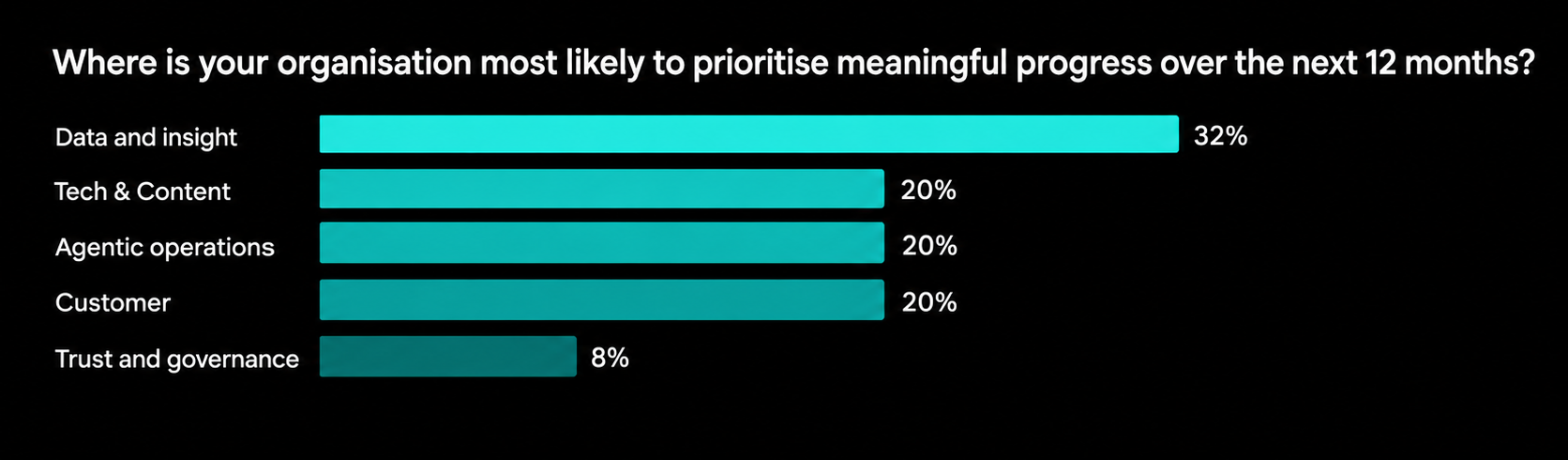 The results suggest organisations are taking a pragmatic approach to AI. Rather than rushing straight towards autonomous agents and advanced orchestration, many leaders recognise that meaningful progress depends on strengthening the foundations underneath. High-quality data, connected systems and actionable insight remain the building blocks of successful AI initiatives.
Perhaps most interestingly, trust and governance ranked lowest among stated priorities. Yet many of the themes raised by the panel suggest governance will become increasingly important as organisations move from experimentation to scale. In an AI-enabled world, trust is unlikely to be just a compliance issue. It will become a differentiator.
Start with outcomes, not technology
Perhaps the strongest consensus across the panel was the importance of focusing on outcomes rather than capabilities.
As AI tools continue to proliferate, it's easy for organisations to become distracted by what is technically possible. The businesses making the greatest progress are taking a more disciplined approach, identifying specific challenges where AI can create measurable value and then building from there.
"I think it's really easy to get swept up in the AI bubble... but it all comes down to what do your customers actually want?"
Alistair Leach, Director of Omnichannel Product, Pets at Home
Whether the objective is improving customer service, reducing operational inefficiency or creating more relevant digital experiences, the most effective initiatives tend to begin with a clearly defined problem rather than a predetermined technology.
As organisations move from experimentation to implementation, the differentiator won't be access to AI. It will be the ability to apply it thoughtfully, responsibly and in ways that solve meaningful problems.
Looking beyond the website
If there was one message that connected both the panel discussion and the audience polling, it was that the conversation around AI is maturing.
The audience data revealed that organisations are eager to embrace AI, but are still focused on building the foundations required to scale it successfully. That mirrors the message from the panel. The greatest opportunities are no longer about experimenting with AI. They are about turning potential into value, whether through better customer experiences, more connected operations or stronger decision-making.
As customer journeys become more distributed and AI increasingly influences how people discover, evaluate and choose brands, competitive advantage won't come from adopting the most technology. It will come from applying it in ways that create relevance, build trust and deliver measurable outcomes.
"Agentic capabilities are incredibly exciting, it's come on leaps and bounds. But it's easy to have it. It's hard to actually land it, demonstrate it and realise the value from it.”
James White, Director of Marketing, Spire Healthcare
That may prove to be the defining challenge of the next phase of AI adoption.
Continue the conversation at Opticon Unwrapped
If you're exploring what agentic customer experiences could mean for your organisation, join us for Opticon Unwrapped. We’re bringing together digital leaders to unpack the key themes from Opticon, discuss what they mean in practice, and explore the steps organisations are taking to turn AI ambition into measurable outcomes.
Find out more and register: Opticon Unwrapped roundtable