Elevate Customer Experiences Skip to main content

Elevate customer experiences

Create personalised experiences for people and agents

Customer journeys no longer always begin with search or end on your website. Create personalised experiences that adapt as people use AI to discover, interact and transact.

Turn changing customer behaviour into competitive advantage

AI is reshaping how customers discover, compare and act. Move now to make every journey more relevant, earn influence with personal assistants and create a competitive advantage. 

Capture emerging demand 
Stay visible and relevant as AI changes how customers discover options, form preferences and choose what to do next. 

Convert intent into growth 
Adapt content and next actions around customer insight and data to increase conversion and build loyalty. 

Deepen customer relationships 
Make each customer feel recognised with personalised experiences that build confidence, loyalty and reasons to return. 

Build an early advantage 
Learn faster from changing behaviour and compound that evidence into stronger personalisation before competitors catch up. 


The customer journey is being assembled elsewhere

Customers once searched, chose a result and navigated a journey designed by the brand. Now answer engines, AI search and personal assistants can identify needs, compare options and recommend a next step before a customer reaches your website. As agents become able to act, parts of the journey may happen without a conventional visit at all.

  • The starting point is shifting

    A need may now be expressed to an AI assistant that already holds the customer’s context, rather than typed into a search box or website navigation.

  • Brands risk disappearing early

    AEO and GEO influence whether answer engines can find, understand, cite and recommend a brand while customers are still forming a shortlist.

  • The interface may belong to the customer

    Personal AI assistants can increasingly research and compare around an individual’s goals and preferences, changing who controls the experience and the context behind it.

  • Your website has a new audience

    For years, websites distinguished between people and bots. Now some agents may represent customers. The question becomes who the agent represents, what it is authorised to do and whether the experience can support a successful outcome.

Design for people and the agents acting for them

The website remains a trusted place to explore, decide and act, but it now serves two audiences. People need intuitive, accessible, persuasive and personalised experiences. Agents need structured meaning, verifiable information, clear actions and the context to complete a customer’s goal effectively.

  • Personalise the human experience

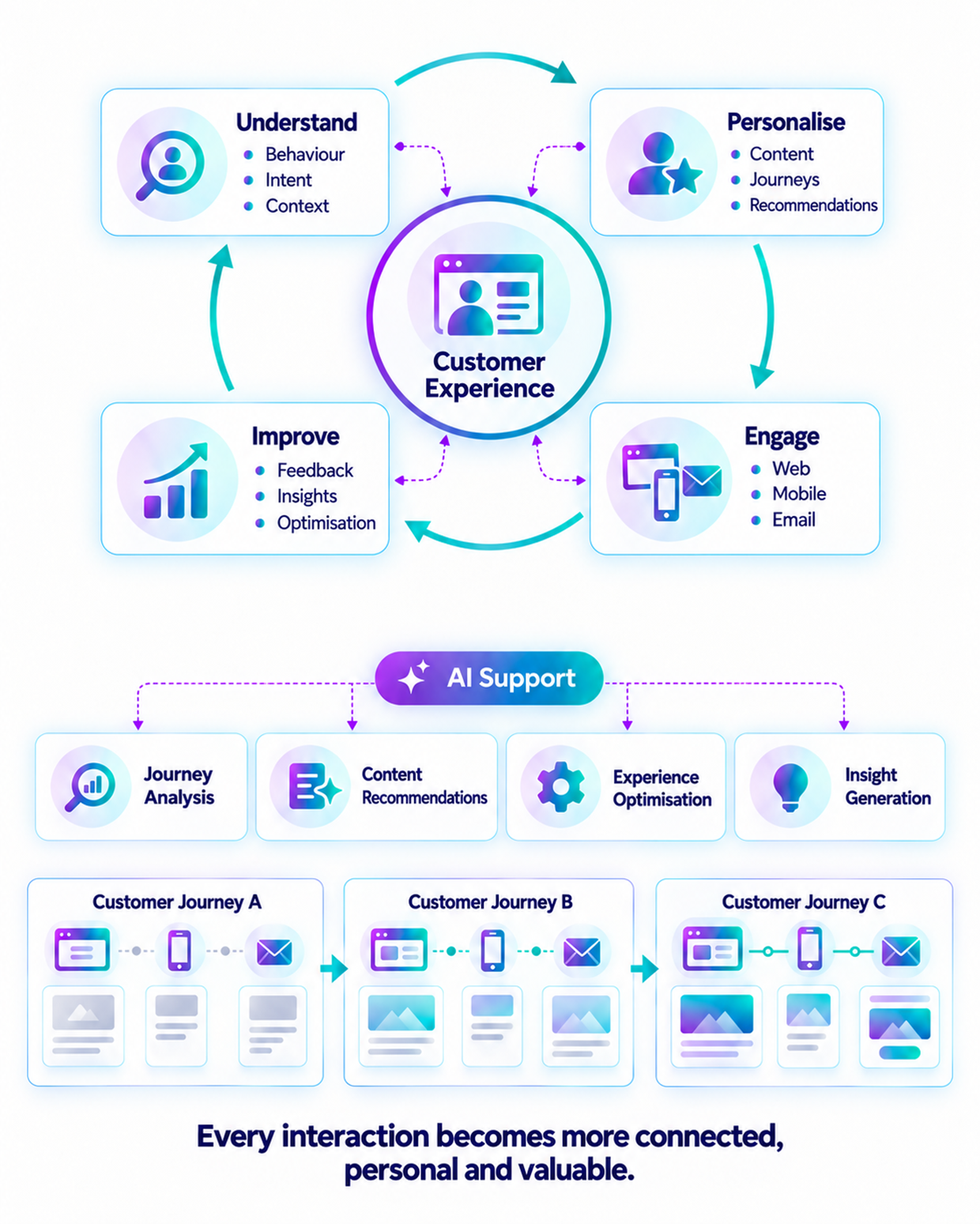
    Customer insight, behavioural signals and real-time context shape relevant content, journeys and next actions around what each person is trying to achieve.

  • Earn discovery and recommendation

    Structured, consistent and authoritative content helps answer engines and personal assistants find, understand, cite and recommend the brand.

  • Make actions agent-ready

    Explicit actions, defined inputs and successful outcomes help authorised agents check availability, request a quote, book, amend or complete another customer goal without imitating a human journey.

  • Keep the journey connected

    Preserve customer context across direct, assisted and agent-led interactions, reducing repetition and disconnected hand-offs so each next step feels relevant and joined up.

Success stories
  • Delivering a more intuitive digital experience that connects guests to relevant content, improves holiday discovery and supports conversion.


  • Driving revenue growth and ongoing agility with a composable Optimizely and Commerce tools architecture.

    Read the story


Turn customer understanding into personalised experiences
  • Customer research and journey insight

    Combine customer research, behavioural evidence and journey analysis to understand changing needs, identify friction and prioritise where personalisation can improve engagement, conversion or loyalty.

  • Human and agent experience design

    Design connected journeys across digital, service and agent touchpoints, shaping intuitive human interactions, effective hand-offs and agent experiences built around clear customer goals.

  • Customer context and decisioning

    Bring consented profile, behavioural, transactional and contextual signals into timely, governed experience decisions.

  • Discoverable, trusted content

    Strengthen SEO, AEO and GEO with authoritative content that people can trust and AI systems can understand, cite and recommend.

  • Personalised content at scale

    Create modular, governed content and variations that can be selected or assembled around different customer needs, contexts and interfaces.

  • Personalisation and optimisation

    Apply real-time personalisation, measure its effect on engagement, conversion, customer effort and loyalty, and carry the learning into the next interaction.

Take the next step in your personalisation journey

Start with the decision that will reduce uncertainty and clarify the route to stronger engagement, conversion or loyalty.

  • Understand today

    Assess how customer discovery and decision-making are changing, where the brand is exposed across AEO, GEO and agent-led journeys, and which moments offer the strongest personalisation opportunity.

  • Define tomorrow

    Define the target journey across human and agent touchpoints, the future role of the website, and the content, data, decisioning and governance needed to deliver it.

  • Prove

    Test one priority adaptive journey, AI-discovery improvement or agent-ready interaction against a defined measure such as engagement, conversion, customer effort, retention or service completion before scaling.

Get in touch

Questions customer experience leaders ask

  • Customer experience design makes it easier for people to achieve what they came to your organisation to do. It considers the whole journey - information, interactions, content and service - so the experience feels clear, joined up and genuinely helpful. 

  • We look at where customers struggle, what they are trying to achieve and what your data already shows. Improvements are tested with real users, prioritised by likely impact and measured after launch, so decisions are based on evidence rather than opinion. 

  • Yes. We can speak to customers, observe how they use your website and test ideas before you invest in building them. That gives your organisation more confidence that the final experience will be understandable, accessible and useful. 

  • We start with moments where recognising a customer's context could genuinely help them. That might mean more relevant content, search or journeys. We test the benefit carefully and only scale personalisation when it improves the experience without feeling intrusive. 

  • Often, yes - especially when people can find information, understand choices and complete tasks more easily. We do not assume every design change will work; we measure important journeys and test significant changes so you can see the real effect. 

  • Yes. We design and test for accessibility throughout the work, rather than treating it as a final checklist. This helps more people use your services, reduces the cost of fixing issues later and supports your organisation's legal and social responsibilities. 

Take your next step

Schedule a call, drop us a message or give us a ring. Whatever helps you take the next step on your journey.

Cameron Day

Director of Partnerships

Get in touch